- The Pulse of the Planet: Tesla’s Last Will and Testament Breaking 100 Years of Silence
- The illusion that “electricity is something that is generated”
- The truth discovered by Nikola Tesla
- Planetary Capacitors
- Resonating the Earth
- Standing wave grid
- Exclusion from society
- [The Breath of the Sun] The mechanism for generating energy from the void
- 0.7% disappearance
- [The Sacred Vessel] The Mystery of Standing Waves that Fix Space
- Chladni figures
- UFO operating principles
- The sun and standing waves
The Pulse of the Planet: Tesla’s Last Will and Testament Breaking 100 Years of Silence
Why isn’t Nikola Tesla as famous as Edison?
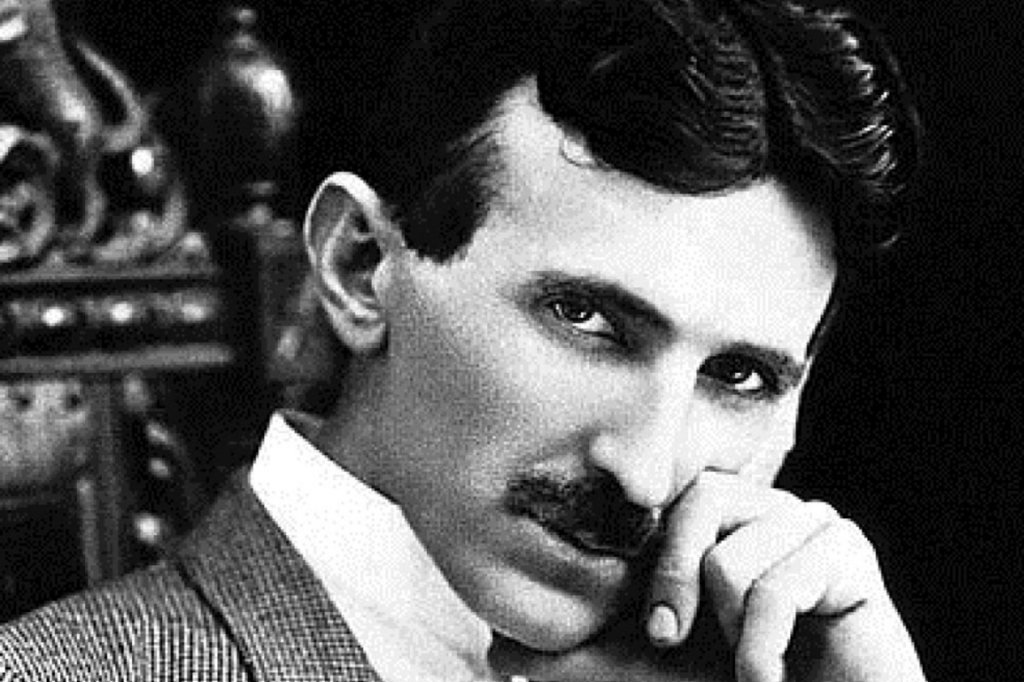
Despite making the groundbreaking invention of practical application of alternating current, a fundamental element of our lives, Nikola Tesla has become synonymous with urban legends. If his inventions hadn’t existed, human progress would have been delayed by decades.
Let’s explore why such a great benefactor has been socially ostracized and why he’s not even mentioned in textbooks.
The illusion that “electricity is something that is generated”
Food, water, housing, cars, clothing, communication, healthcare, and schools—all essential to our lives—rely on electricity. And that electricity is supplied to us through oil and nuclear power generation. Life without these things would be tantamount to death; they are absolutely indispensable to us.
It’s no exaggeration to say that we work for this very reason.
Without money, electricity is cut off, and we cannot obtain any other infrastructure or goods that rely on electricity.
What if electricity were free? The price we pay would drop dramatically, and we would undoubtedly live a more comfortable life. However, in reality, this seems impossible.
Electricity doesn’t just appear out of thin air; it requires some kind of energy conversion.
To generate alternating current, you need to turn a turbine and rotate the magnets in an electromagnetic coil.
Electricity can only be produced through this reverse motion of a motor. Solar power generation is an exception, of course.
To simply rotate the shaft, we burn oil, heat water with nuclear power, and use the hydroelectric power of dams.
What an inefficient energy source!
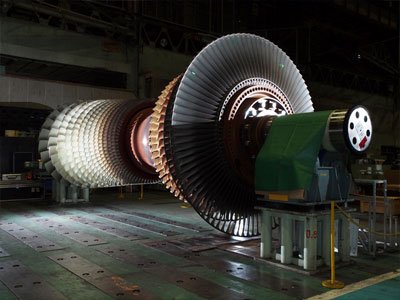
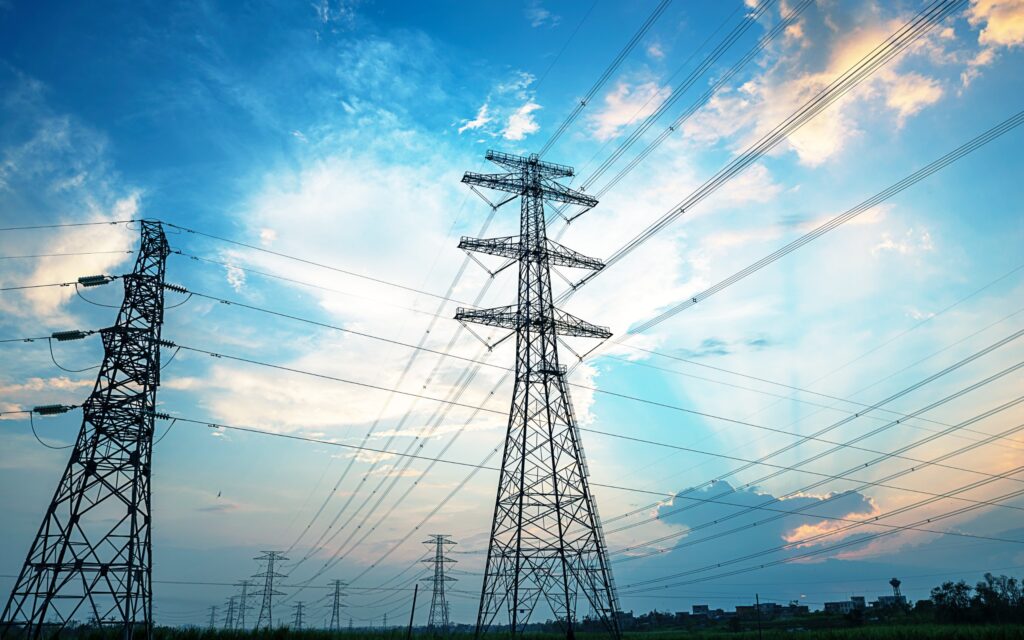
Moreover, the alternating current electricity that is generated is lost as heat due to the resistance of transmission, further reducing its amount.
By the time it reaches our home electricity meters, 4 to 9 percent has been wasted. This 4 to 9 percent transmission loss, when viewed across Japan, is equivalent to the electricity generated by several medium-sized nuclear power plants disappearing without benefiting anyone.
Is it possible to generate electricity from nothing?
This seems impossible given the current understanding that electricity is generated from rotation.
The truth discovered by Nikola Tesla
Once, there was a man who dreamed of this: Nikola Tesla. He envisioned using the Earth itself as a giant musical instrument to distribute energy to the world free of charge. However, his dream was buried in the shadows of history by the greedy logic of capital, which dictated that “meters cannot be attached.” Now, 100 years later, the time has come to knock on that door once again.
Nikola Tesla’s envisioned Earth system was not the ramblings of a madman.
He viewed the planet Earth itself as a single, gigantic electrical circuit. He envisioned Earth as a giant capacitor, where energy could be stored, and that electricity could be extracted from anywhere in the world.
Earth is a giant battery.
This system wasn’t about energy conversion through rotation, but rather a conversion that could extract natural energy in a form usable by humans. Let me explain its structure.
Tesla viewed the earth we stand on as a conductor, and the ionosphere far above as another conductor. The atmosphere in between is an insulator. In other words, he realized that the Earth itself is a giant capacitor (energy storage device).
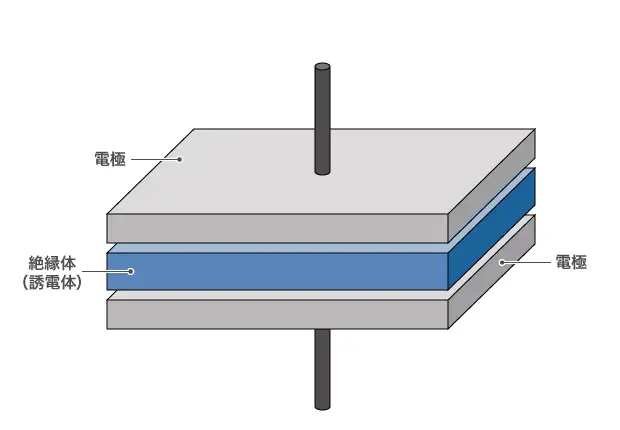
Planetary Capacitors
His conviction in the grand concept of the “Earth System” stemmed from an event on a stormy night at his Colorado Springs laboratory on July 3, 1899.
This event transcended mere scientific discovery; it was the moment he became convinced that the Earth was alive (vibrating electrically). He had been paying attention to the clear air of Colorado Springs and the frequent, violent thunderstorms. That day, a massive thundercloud rolled in from the western mountains, causing tremendous electrical discharges.
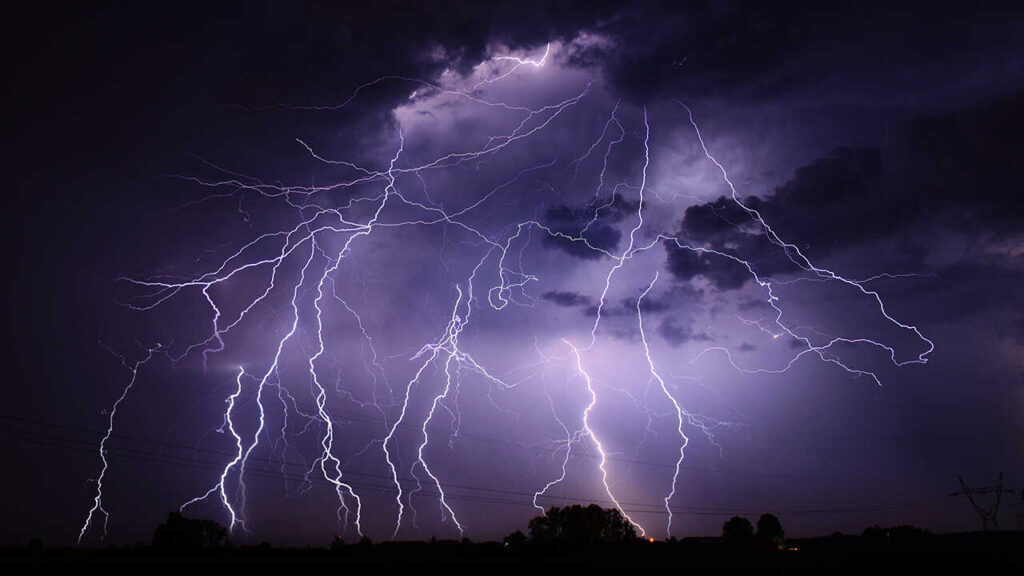
Even after the storm had moved eastward and the lightning was no longer visible to the naked eye, his keen observation instruments continued to detect a strange signal. The signal’s intensity did not decrease monotonically as the storm receded, but rather fluctuated regularly, becoming stronger and weaker.

Tesla intuitively understood this phenomenon as electromagnetic disturbances caused by lightning traveling to the other side of the Earth, where the reflected waves overlapped with those of lightning. This discovery convinced him that the Earth is a finite-sized conductor and that it can be made to resonate at specific frequencies.
Tesla reasoned that if natural lightning could produce such phenomena, then artificially shaking the Earth using a amplification transmitter would allow energy to be delivered worldwide without the need for power lines.
Tesla wrote in his diary: “The Earth is literally filled with electrical vibrations.”
This became the origin of the Earth system, which transforms the Earth itself, a vast vessel, into an energy ocean, allowing everyone to obtain power from it as easily as breathing. The structure of a capacitor is surprisingly simple. Two electrically conductive plates (conductors) face each other without touching, separated by an electrically insulating wall (insulator). That’s all there is to it.
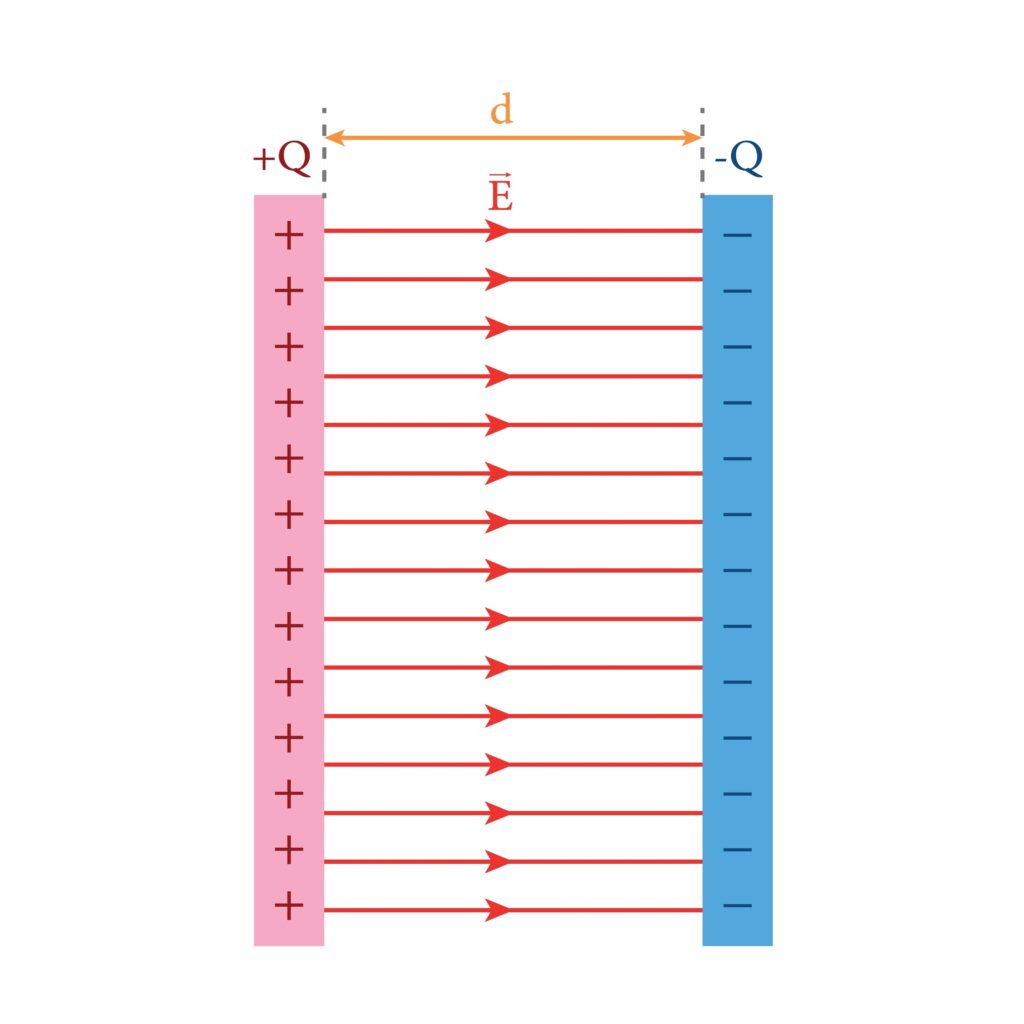
However, it is precisely in this non-contact that the profound rules of the universe are hidden.
If you introduce a positive charge to one plate and a negative charge to the other, they will attract each other intensely. This is because positive and negative charges have a fundamental desire in the universe to “become one.”
However, the insulator between them cruelly prevents their connection. They want to go, but they cannot. They want to be connected, but they cannot touch. This heightened “frustration” intensely distorts the space between the two plates. This distortion is the electric field, a state in which energy is stored as invisible tension.
Many people mistakenly believe that storing electricity is a material accumulation, like filling a bucket with water. But in a capacitor, energy storage is not about increasing the number of buckets. It’s more like drawing a bowstring to its limit.

When a bowstring is drawn taut, there is no dynamic motion (rotation). However, when the string is released, a powerful force that propels the arrow is hidden within. A capacitor is a device that creates this taut string in space. In a capacitor, the most important element is not the electrically conductive plates. In fact, the insulator between them is the main character of the story.
In conventional electrical engineering, insulators have simply been treated as something that blocks electricity. However, when we reconsider them from this perspective, a completely different picture emerges. Inside an insulator placed in an electric field, a phenomenon called dielectric polarization occurs at the atomic level. The molecules inside the insulator align themselves in response to the tension between the positive and negative charges outside, creating a small state of tension, an electric field, within themselves.
This can be described as a state in which the inner world (microcosm) resonates with the will of the outer world (macrocosm). The higher the dielectric constant of this insulator, the more energy the capacitor can confine in a smaller space.

The lower electrode plate, the earth on which we stand. This is a massive conductor containing moisture and minerals.
The upper electrode plate, the ionosphere, which extends above an altitude of approximately 60 km. Ultraviolet rays from the sun and cosmic rays ionize the air, separating it into positive and negative charges, creating a layer that conducts electricity well.
The insulator, the atmosphere we breathe, sandwiched between these two plates.
A potential difference of approximately 250,000V to 400,000V is constantly maintained between the Earth’s surface (negative pole) and the ionosphere (positive pole). This potential difference reaches approximately 100 to 300 volts at a height of just one meter above the ground. We are literally walking on a capacitor packed full of energy.
As we have seen, a capacitor is an extremely pure physical device that mimics the tension (electric field) created between the Earth and the ionosphere. However, this device has a fatal weakness: the stored energy is extremely prone to escaping.
The moment electricity flows through a capacitor, a strong attraction between positive and negative charges is indeed created. But the moment the circuit to the outside is opened, that tension flows out with tremendous force, instantly returning to zero. Alternatively, even if the circuit remains closed, the energy continues to leak out at a minute through the atmosphere and insulators, eventually disappearing quietly.
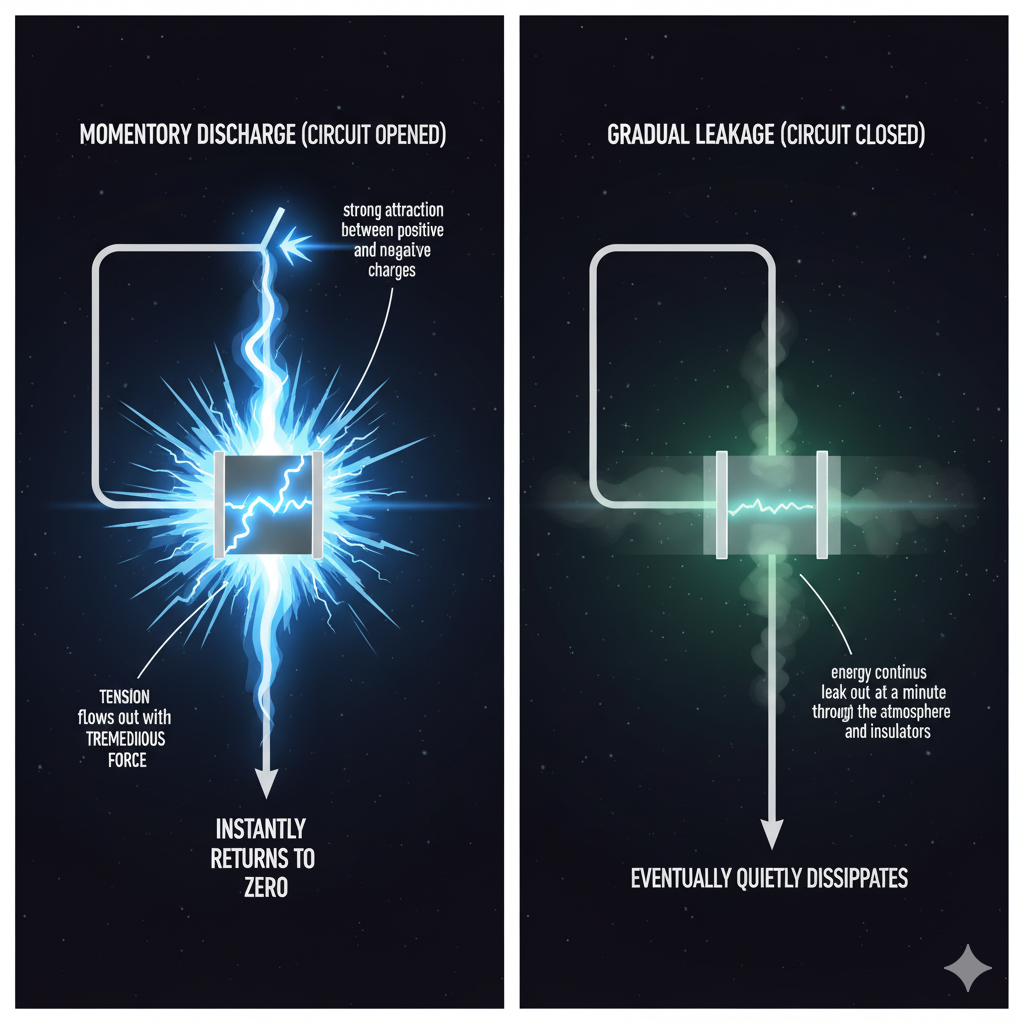
“It disappears quickly even if you store it, and it vanishes instantly if you try to take it out.”
Tesla’s thought was, “But what if we could fix this fading energy in a specific space without letting it disappear or release it all at once?”
His true genius lay in his engineering approach of an enormous scale: “violently shaking this silent energy storage device at a specific frequency to resonate the entire planet.”
Resonating the Earth
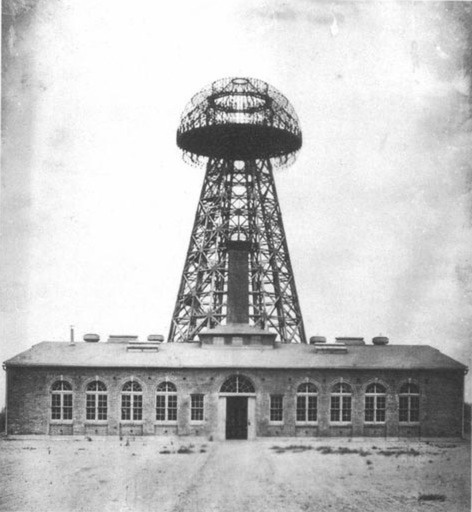
The augmented transmitter that Tesla attempted to create in the Wardenclyffe Tower was not merely a wireless transmitter. It was a giant heart pump designed to deliver electrical shocks to the Earth, a massive capacitor, causing planet-wide resonance and generating standing waves.
Normally, traveling waves carrying energy constantly try to move. They always have a tendency to go somewhere, and in the process of movement, they encounter resistance and lose energy as heat. However, standing waves are different. In short, a standing wave is a wave that confronts itself and engages in a dialogue with itself.
The outgoing wave bounces off a wall and returns as the return wave. When these two outgoing waves overlap in the exact same location in space, with the exact same rhythm, the wave decides to “stay” in that place. The force trying to move to the right and the force trying to move to the left are perfectly balanced and reconciled.
At this point, the energy stops moving and becomes fixed in a specific location.
It is as if space itself is embracing the energy and pulsating in that place. The electric field created between the capacitor plates is perfectly aligned with the “antinode” (the point of maximum vibration) of this standing wave. Then, the energy that would normally try to escape is quietly, yet powerfully, pinned down within the ordered cage of the standing wave.
Standing wave grid
Energy fixed as a standing wave does not diminish like water in a bucket. It remains there as a property of the “field.” Even if one person draws energy from the field, as long as the whole continues to resonate correctly, new energy is constantly replenished, and the standing wave is maintained.
The greatest characteristic of a standing wave is that it creates a physical structure within space. If a traveling wave is a chaotic flow of water that flows endlessly and disappears, then a standing wave is an energy grid that divides space in all directions.
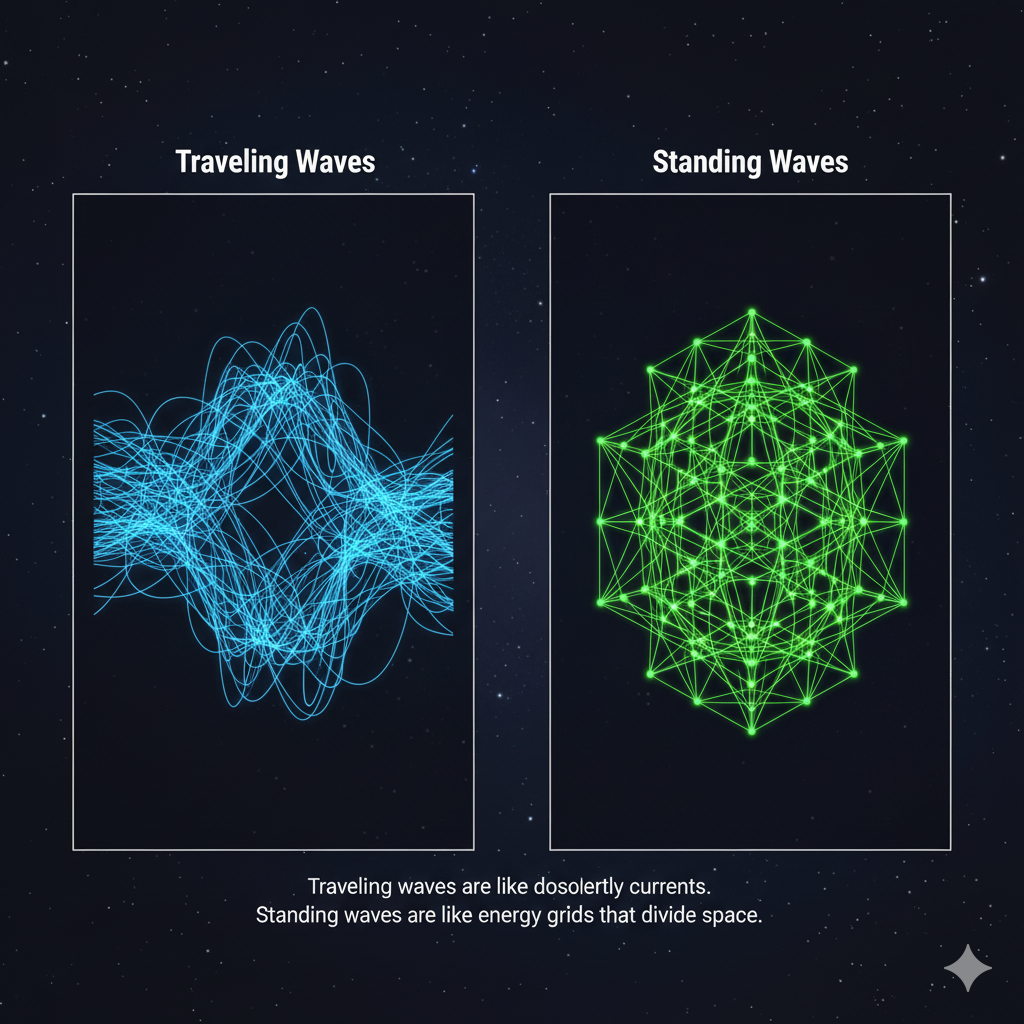
In space where standing waves are generated, energy is concentrated at “antinodes,” and their positions are fixed by “nodes.” This is equivalent to transforming space itself into a charged crystal, rather than simply storing energy in a bucket. Tesla sought to extend this grid across the entire Earth, creating a state where, no matter where you are on Earth, a source of energy is always waiting a short distance from the ground.
The frequencies Tesla attempted to send from the Wardenclyffe Tower to Earth ranged from those close to the “Schumann resonance (7.83 Hz)” we know today, to higher-order harmonic waves. Based on his experiments in Colorado Springs, Tesla calculated the natural frequencies of the Earth, a giant conductor, ranging from a fundamental frequency of 6 Hz to 12 Hz. Using the Earth’s diameter and the speed of light (and the speed of electromagnetic waves traveling through the Earth’s interior), he identified a range of approximately 6 Hz to 12 Hz as the fundamental tone for resonating the entire Earth.
In particular, Tesla emphasized the frequency at which waves would reach the other side of the Earth and return to their original position with pinpoint accuracy. He estimated the time it takes for a wave to travel around the Earth’s circumference to be approximately 0.08 seconds, and considered its reciprocal, around 12 Hz, to be the ideal pulsation for fixing a global standing wave. However, in actual power transmission, excessively low frequencies (low frequencies) would result in equipment that is too large.
Therefore, Tesla used the Earth as a massive resonator, with a high-frequency carrier wave riding on top of it. The planned operating frequency for the Wardenclyffe Tower is said to have been around 150 kHz. This was an extremely practical engineering choice, minimizing the Earth’s impedance and facilitating tuning on the ground.
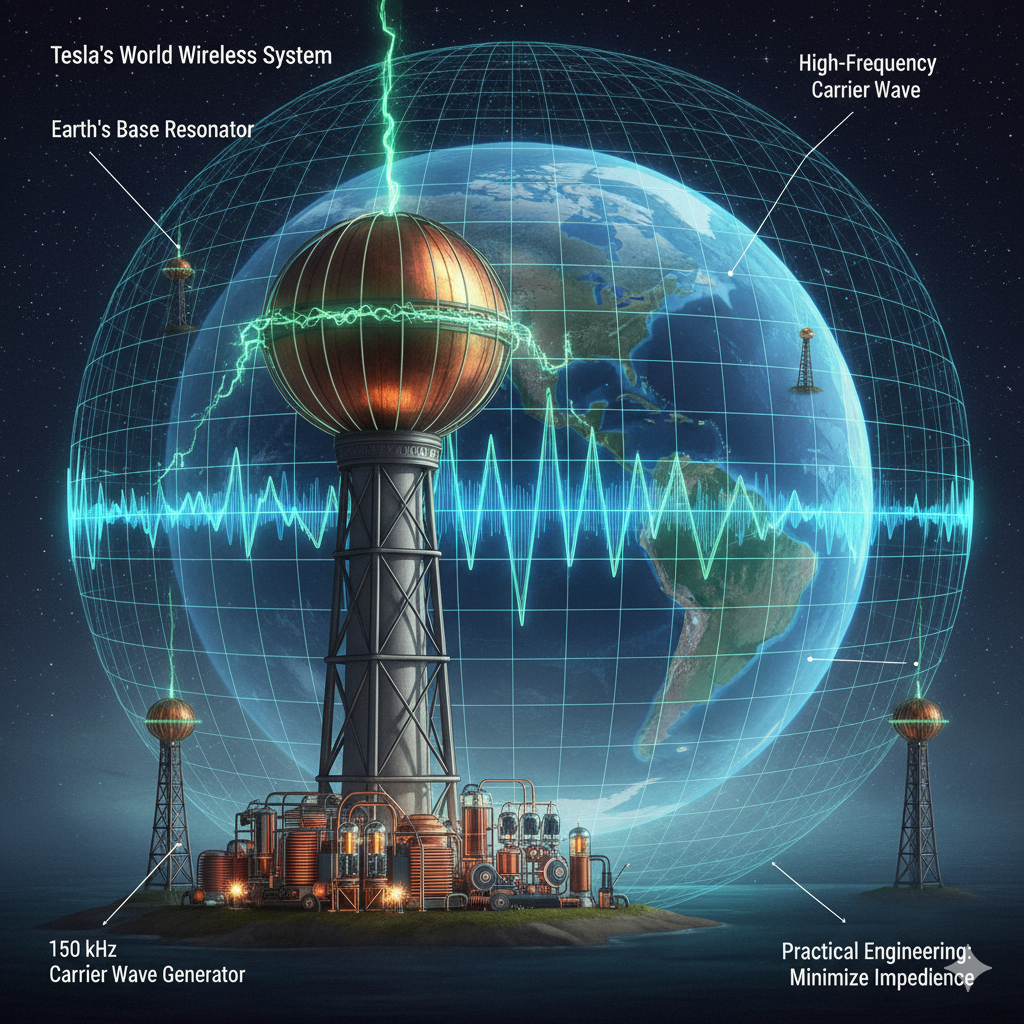
The envisioned power and voltage: The power Tesla intended to pour into this Earth system far surpasses the concept of modern power plants. 100 million volts of tension: Tesla knew that ordinary “pressure” would not be enough to shake the Earth, a giant capacitor. In designing the Wardenclyffe Tower, he aimed to generate ultra-high voltages ranging from several million volts to ultimately reaching 100 million volts. This is equivalent to artificially creating continuous lightning. Increasing the voltage increases the tension in space (the insulator).
Tesla attempted to maintain the energy field by fixing this overwhelming wall of tension as a standing wave across the entire Earth. In the concept of recirculating power (watts) of undiminished energy, Tesla aimed for circulation, not consumption. In a standing wave state, most of the transmitted power continues to circulate between the device and the Earth as reactive power.
The energy maintained in the field is equivalent to millions or tens of millions of kilowatts of resonant energy. Once the entire Earth reaches a state of standing wave resonance saturation, the only additional energy that needs to be transmitted is what has been drawn (consumed) by people all over the world. This is a fundamentally different, ultra-efficient resonant circulation system from modern systems that rely on transmission losses and simply let energy flow freely.
The receiving device in Tesla’s concept was essentially a radio. Synchronization was achieved through coils; the receiving side required neither heavy wires nor transformers. It involved grounding, installing a Tesla coil (resonant circuit), and precisely tuning it to the Earth’s standing wave frequency. Then, energy flows from the “antinodes” of the standing waves, which were fixed in space, into the receiving coil. At this point, the receiving device does not take energy, but rather becomes part of the Earth’s overall resonance system.
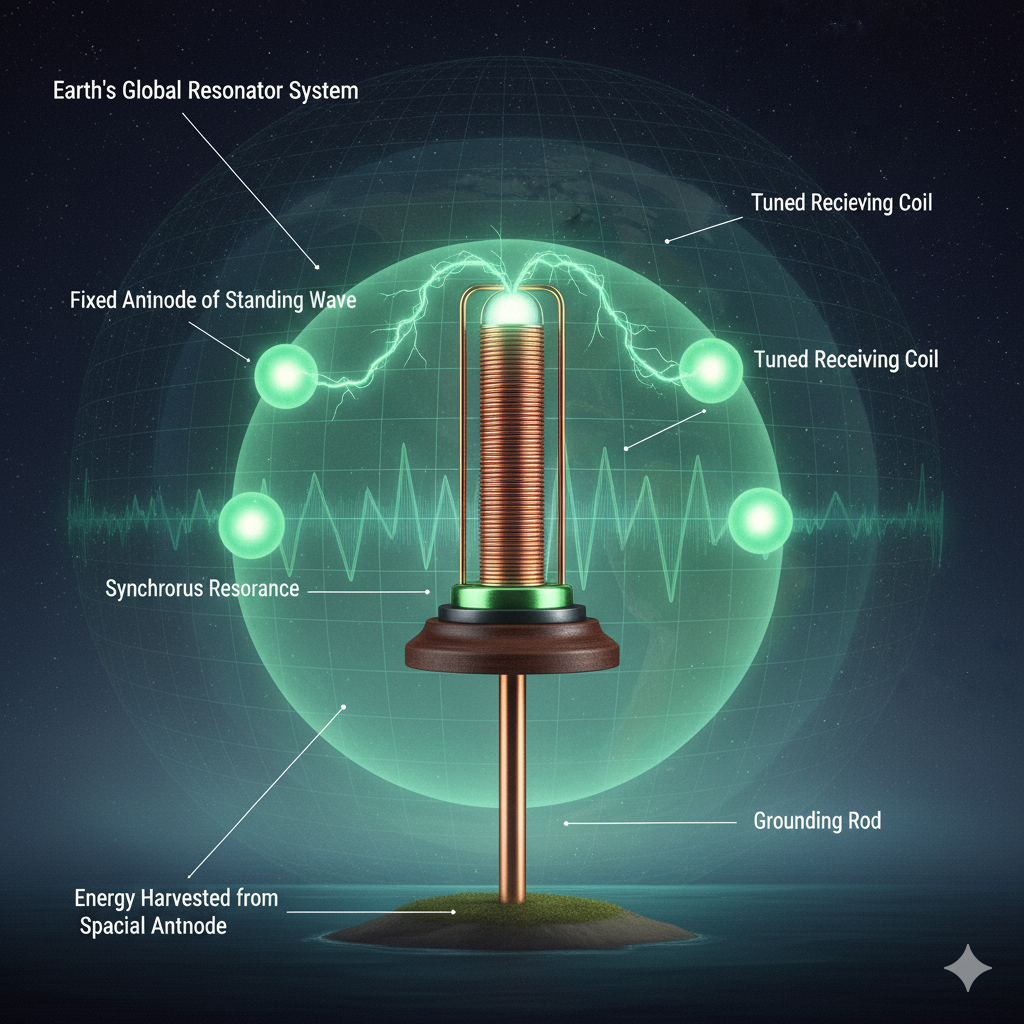
The Earth’s battery is constantly supplied with energy from sources like lightning and cosmic rays. The immense energy quickly fills it up. All we need to do is prevent it from escaping as standing waves. We simply need equipment like radios to extract energy from the ground.
Capitalism has put a stop to this invention.
Exclusion from society
As construction of the Wardenclyffe Tower progressed, investor J.P. Morgan posed a brutal question to Tesla: “Tesla, your plan is brilliant. But if anyone can freely extract energy, where exactly are you going to put the electricity meters?”

This single statement encapsulates everything about the current logic. In the logic of capital, value is created through scarcity and monopoly; anything that everyone can obtain infinitely and for free is not considered wealth. Tesla’s envisioned system was a truly shared technology, allowing everyone to share energy as naturally as breathing, from the public sphere of Earth. However, for those who profited from shutting off the tap, a world without a tap was nothing short of terrifying.
Morgan immediately cut off further funding and banished Tesla from the historical stage as a madman. This resulted in the following three chains being imposed upon our world: the chain of power lines, a denial of the standing waves that fill space, and a fixation on an inflexible system that generates electricity from rotation and transmits it through resistive (lossy) copper wires.
The meter, a chain of mental control that constantly links the energy that forms the basis of life to scarcity and payment. Educational concealment that relegates concepts like the chain of information, the Earth as a capacitor, negative resistance, and standing waves to the categories of occult and impossible, even in textbooks.
As a result, we have come to accept as common sense the insane inefficiency of continuously wasting the equivalent of several medium-sized nuclear power plants’ worth of electricity as heat into the air, solely for the purpose of transmission. Along with Tesla’s buried dream, our freedom was buried as well.
Bearing the grave sin of “not being able to install meters.”
Tesla’s Legacy and Legacy: An Archive to Explore the Historical Background of Buried Technology
[The Breath of the Sun] The mechanism for generating energy from the void
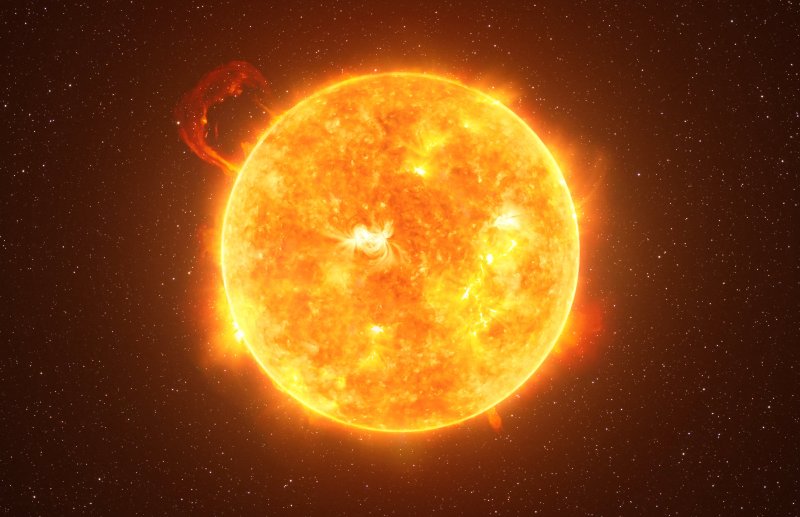
For ancient people, the sun was not merely a shining celestial body, but “God itself,” the entity that breathes life into all things and governs the order of the world. They revered the sun as a golden chariot soaring through the heavens and a great eye that gives birth to life, sensing the will of the universe in its light.
The description of the energy source of stars that we have been taught without question from compulsory education to higher education is a perfectly closed fuel consumption model based on thermodynamics and nuclear physics. In this model, the sun is defined as a gigantic fireball that continuously burns its own finite fuel until it eventually dies coldly. In modern academia, the story of stars begins with their contraction due to gravity.
When a massive cloud of gas drifting in space contracts under its own gravity, its potential energy is converted into thermal energy (virial theorem).
As the contraction progresses, the density and temperature of the core increase, and when it reaches several million Kelvins, hydrogen fusion begins.
While hydrogen is burning, the inward gravity and the outward radiation pressure from the heat of nuclear fusion are in perfect balance, maintaining a constant size for the star.
When the star runs out of hydrogen, helium, the waste product, accumulates in its core.
This is where the second act of gravity and nuclear fusion begins.
With the loss of its energy source (hydrogen), the radiation pressure weakens, and gravity once again prevails, beginning to violently compress the core.
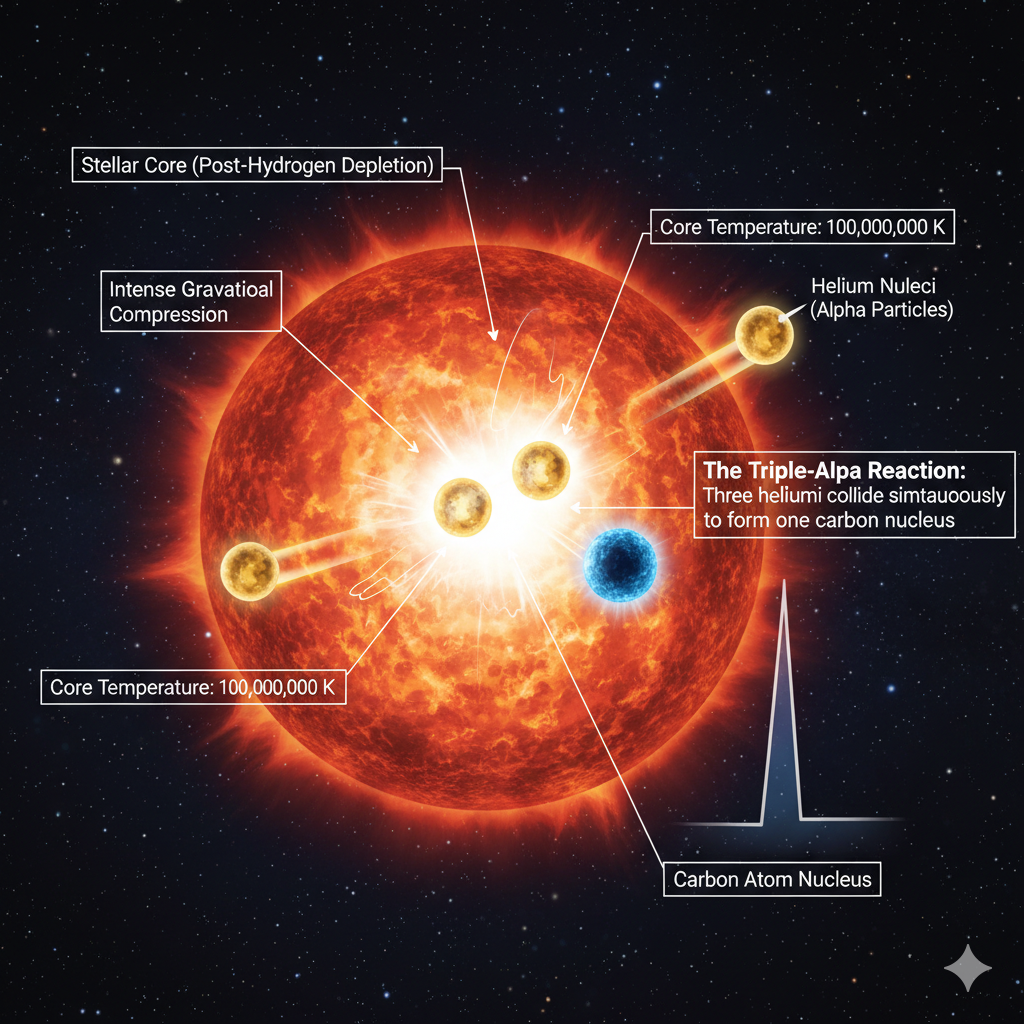
This re-contraction causes the core temperature to reach an unimaginable range of approximately 100 million K (Kelvin).
The moment it reaches 100 million K, three helium nuclei (alpha particles) collide almost simultaneously, initiating the “triple alpha reaction” that produces a single carbon nucleus.
Textbooks explain the energy gained from this reaction using the concept of “mass defect.”
When the temperature exceeds the critical point, the sun enters a stable phase as a main-sequence star.
The energy source at this stage is the reaction in which hydrogen nuclei (protons) fuse to form helium nuclei.
The most basic reaction equation presented in textbooks is the process in which four hydrogen nuclei transform into one helium nucleus.
The core of this reaction lies in the “mass defect” based on Einstein’s famous equation E = mc^2 .
0.7% disappearance
The mass of the generated helium nuclei is approximately 0.7% lighter than the combined mass of the original four hydrogen nuclei. This “vanished mass” is explained as the immense energy that illuminates the universe.
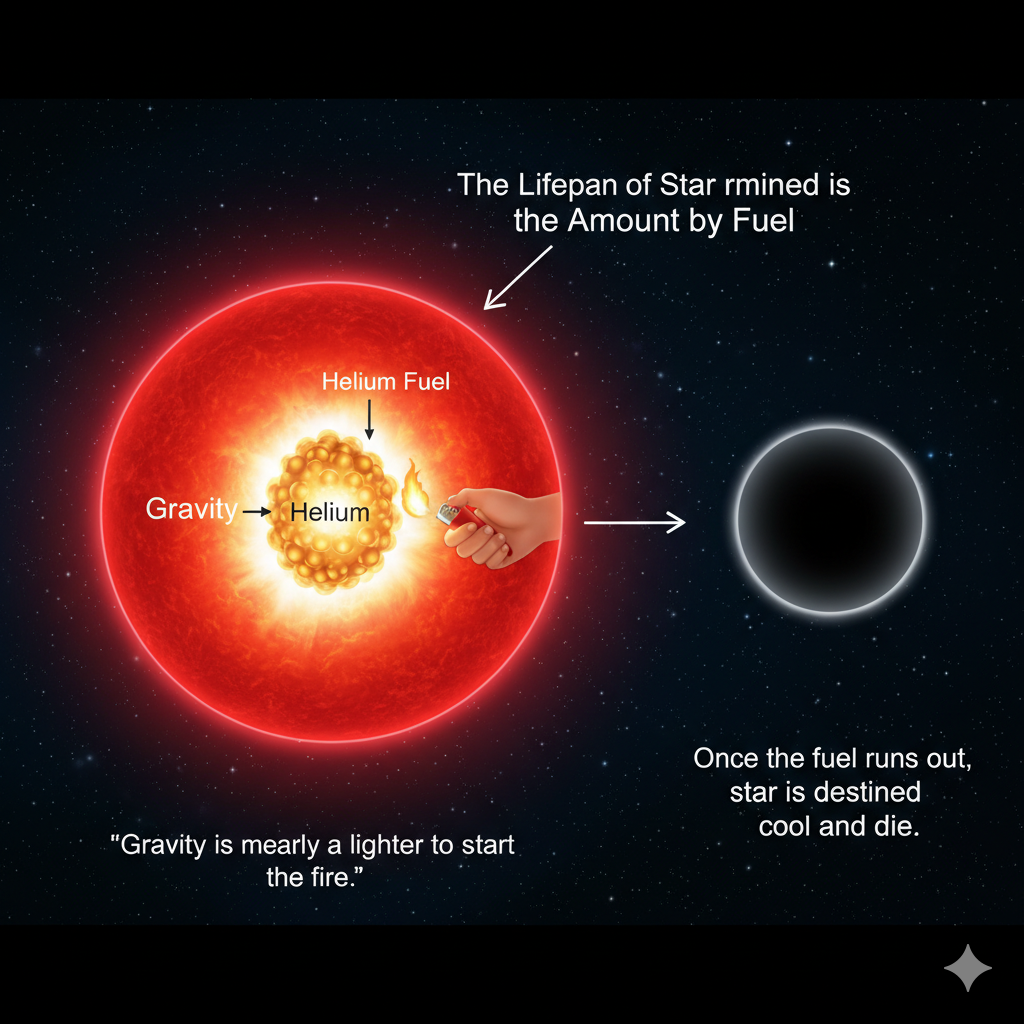
The core of this model lies in the idea that a star’s lifespan is determined by the amount of fuel it contains. In other words, gravity is merely a lighter to start the fire; once the fuel (helium) runs out, the star is destined to cool and die.
One of the most beautiful mathematical formulas in textbook models is that of hydrostatic equilibrium.
\frac{dP}{dr} = -\rho(r) \frac{GM(r)}{r^2}Inward gravity, a force that tries to crush the star. Outward radiation pressure, the force that tries to release the energy of nuclear fusion outwards.
A state in which these two forces are perfectly balanced is considered to be the stability of a star. However, this equilibrium is merely stability on thin ice. When the fuel runs out, this equilibrium collapses, and the star heads towards death (supernova explosion or cooling to become a white dwarf).
All that remains here is stagnation in the name of equilibrium and an end in the name of fuel depletion.
However, a detailed observation of the sun’s behavior reveals many inconsistencies in the model that assumes energy flows unilaterally from the interior to the exterior.
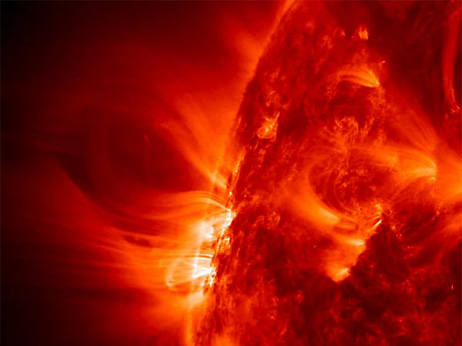
One such inconsistency is the fact that the “corona,” far above the sun, is overwhelmingly hotter than the sun’s surface. While the sun’s surface temperature is approximately 6,000 degrees Celsius, the corona far above reaches extremely high temperatures exceeding 1 million degrees Celsius.
Official article on the “paradox” that the corona is hotter than the sun’s surface.
If the sun were a furnace burning fuel at its core, then according to thermodynamics, the temperature should decrease as you move away from the center. However, the opposite phenomenon is occurring.
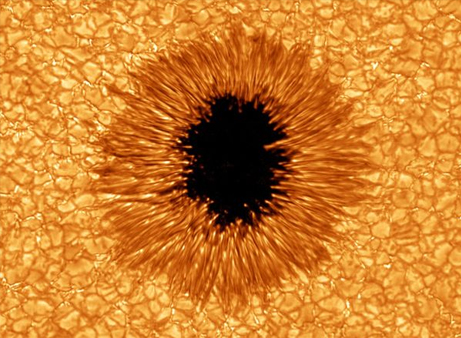
The “sunspots” that appear on the surface of the sun are also a contradiction.
Textbooks explain them as areas where thermal convection is inhibited by a strong magnetic field, causing the temperature to drop.
However, detailed observation of sunspots reveals the existence of a “hole” opening towards the center, and its bottom is clearly “darker and colder” than the surrounding area.
If the center were the site of a nuclear fusion reaction at tens of millions of degrees, unimaginable light and heat should be pouring out from the bottom of that hole. However, in reality, the bottom of sunspots is shrouded in silence.
The biggest mystery, however, is, “Why can the sun continue to shine for hundreds of millions of years without burning out?”
According to the “Standard Solar Model,” the sun has gradually increased in brightness since its birth 4.6 billion years ago through internal nuclear fusion reactions.
However, when we trace this theory back into the past, we encounter a huge, inescapable contradiction.
According to the textbook theory, namely the “fuel consumption model,” calculations show that the sun about 4 billion years ago was only about 70% to 75% of its current brightness.
In modern science, the energy source of stars is attributed to the “mass defect” that occurs when hydrogen nuclei fuse to form helium.
This theory concludes that as time passes, the amount of helium in the core increases, leading to higher density and temperature, and thus increasing the efficiency of nuclear fusion, thus explaining why the sun “gets hotter as it ages.”
If we believe this theory, the energy Earth experienced 4 billion years ago was negligible, comparable to the energy received by the vicinity of Mars today.
The average temperature of Earth at that time should have been far below freezing, and the oceans should have been frozen solid to the bottom, resulting in a “snowball Earth” (global glaciation).
However, the “facts” presented by geology and paleontology directly contradict the textbook calculations.
Sedimentary rocks formed by water currents have been discovered in geological strata dating back over 3.8 billion years. This is irrefutable evidence that liquid water was abundant on Earth at that time.
Furthermore, the oldest fossils (such as stromatolites) indicate that life was active in warm oceans more than 3.5 billion years ago.

The ratio of oxygen isotopes in rocks from that time suggests that sea temperatures were similar to, or even warmer than, today.
The sun was “dim (presumably),” yet the Earth was “warm.”
This desperate discrepancy is the faint sun paradox.
There is a gap between the actual observational results and the logical conclusion. One of them must be wrong.
The answer provided in textbooks is, “The reason the sea didn’t freeze despite the sun being dark is because the atmosphere at that time contained hundreds to thousands of times more carbon dioxide and methane than it does now, creating a powerful greenhouse effect that kept the Earth warm.”
However, this also has many flaws.
Examining the degree of iron oxidation in the soil at that time reveals no evidence of such high concentrations of carbon dioxide.
Even assuming insulation by methane and ammonia, these would be easily decomposed by ultraviolet radiation from the sun, making it impossible to maintain the greenhouse effect.
If the observational results are correct, then questioning the logic is common sense.
The sun is not a gravity-based nuclear fusion reactor.
Let’s return to the question.
“Why can the sun continue to shine for hundreds of millions of years without burning out?”
It is true that the sun burns something.
However, we have learned that it is not a nuclear fusion reactor that burns its own body.
“When you light a fire in an incinerator, what do you burn?”
“That’s household garbage or fallen leaves from the garden.”
“You don’t burn the incinerator itself. That’s right, an incinerator is a device that burns some kind of resource.”
“In other words, the sun is simply an incinerator that collects resources from space and burns them.”
The reason the sun doesn’t burn and lose energy is because it is constantly collecting resources from space and burning them.
“So, what exactly is this ‘resource recovered from space’?
It’s neither oil nor coal, nor the hydrogen gas that textbooks talk about, but the electromagnetic tension that fills the void of the vacuum. In other words, it’s the ‘ether’ that Tesla discovered, the infinite potential that space itself possesses, which modern science calls ‘zero-point energy’.”
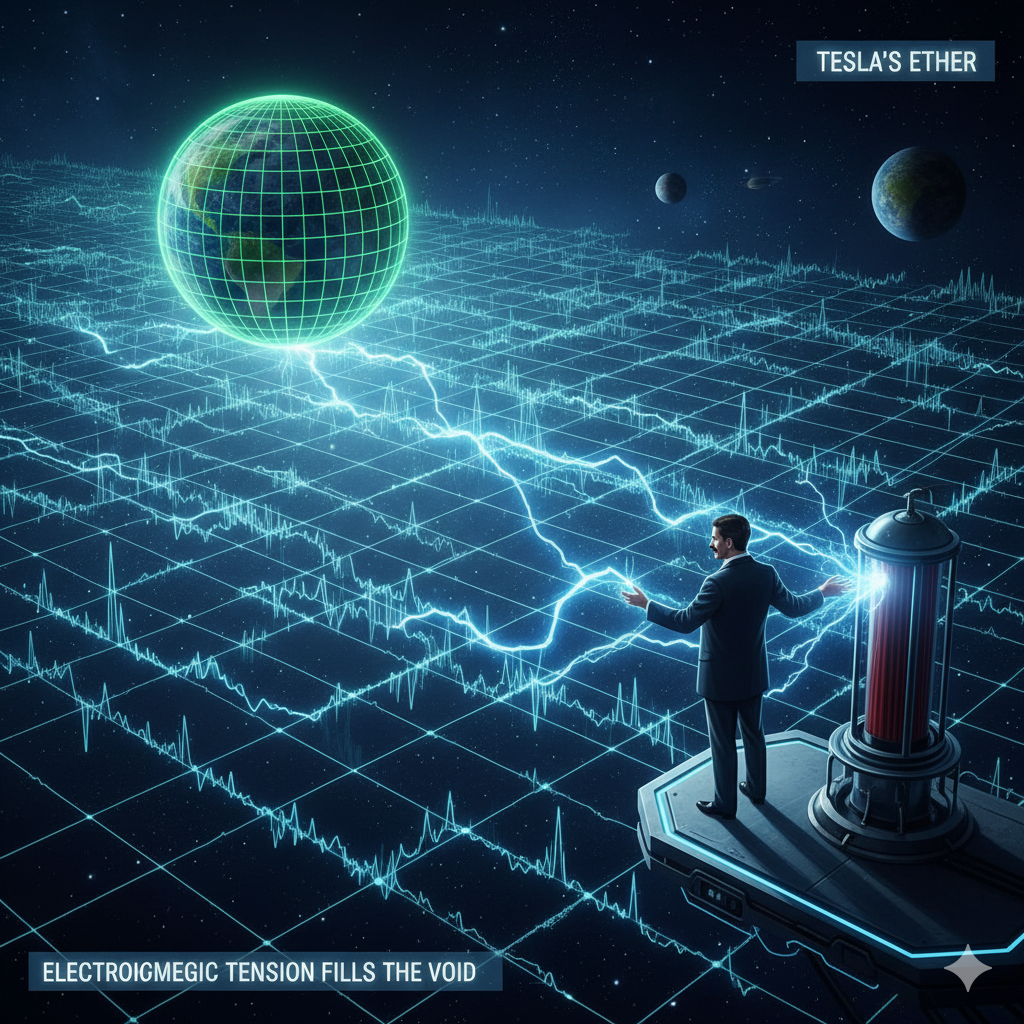
The sun absorbs the tension in this space as if drawing it in with a giant lung, translating it into light and heat that we can use.
However, conventional physics teaches us that extracting energy always requires a cost (loss due to resistance).
“Does this phenomenon of energy absorption even exist?”
The key to unlocking this secret lies in a special ‘behavior’ that fundamentally overturns the common sense of electrical circuits we are familiar with.
In a typical electrical circuit, resistance is the villain, consuming energy and releasing it as heat. According to Ohm’s law [V = IR], the more current flows, the greater the voltage drop and the more energy is lost.
This is physics based on the premise of competition and loss. However, in the universe, there exists a “sacred realm” with the exact opposite properties: “negative resistance.”
Negative resistance refers to a nonlinear phenomenon where the usual laws of physics are reversed: lowering the voltage increases the current, or increasing the current decreases the voltage. In this realm, resistance doesn’t consume energy; instead, it begins to function as a pump, drawing energy from the outside (space) and “supplying” it to the circuit.
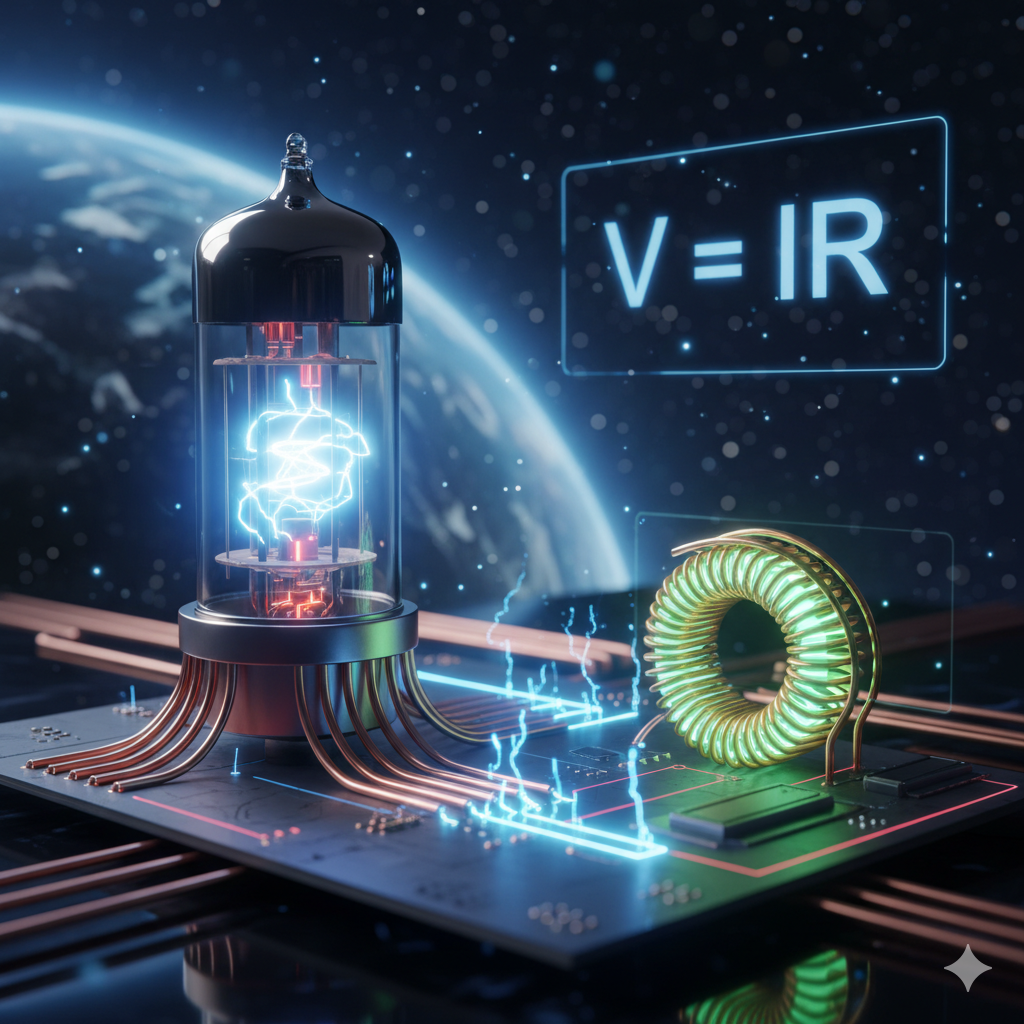
The sun is a gigantic “negative resistor” floating in a sea of infinite potential. The medium that enables this negative property is plasma.
Plasma, where gas is highly ionized and positive and negative particles move freely, is a substance that strongly exhibits wave-like properties. Within the plasma, this negative property becomes particularly pronounced in specific voltage ranges.
The key here is not simply discharging the plasma, but pulsating it at a constant rhythm within a fixed central field. When this pulsation synchronizes with the standing waves of the universe, the plasma ceases to be merely a glowing gas. It evolves into a “heart that draws energy from the ocean of vacuum.”
When we remove the existing scientific lens that views the sun simply as a giant nuclear fusion reactor and redefine it as a negative resistor in the vast resonant system of the universe, a completely new landscape will unfold before us.
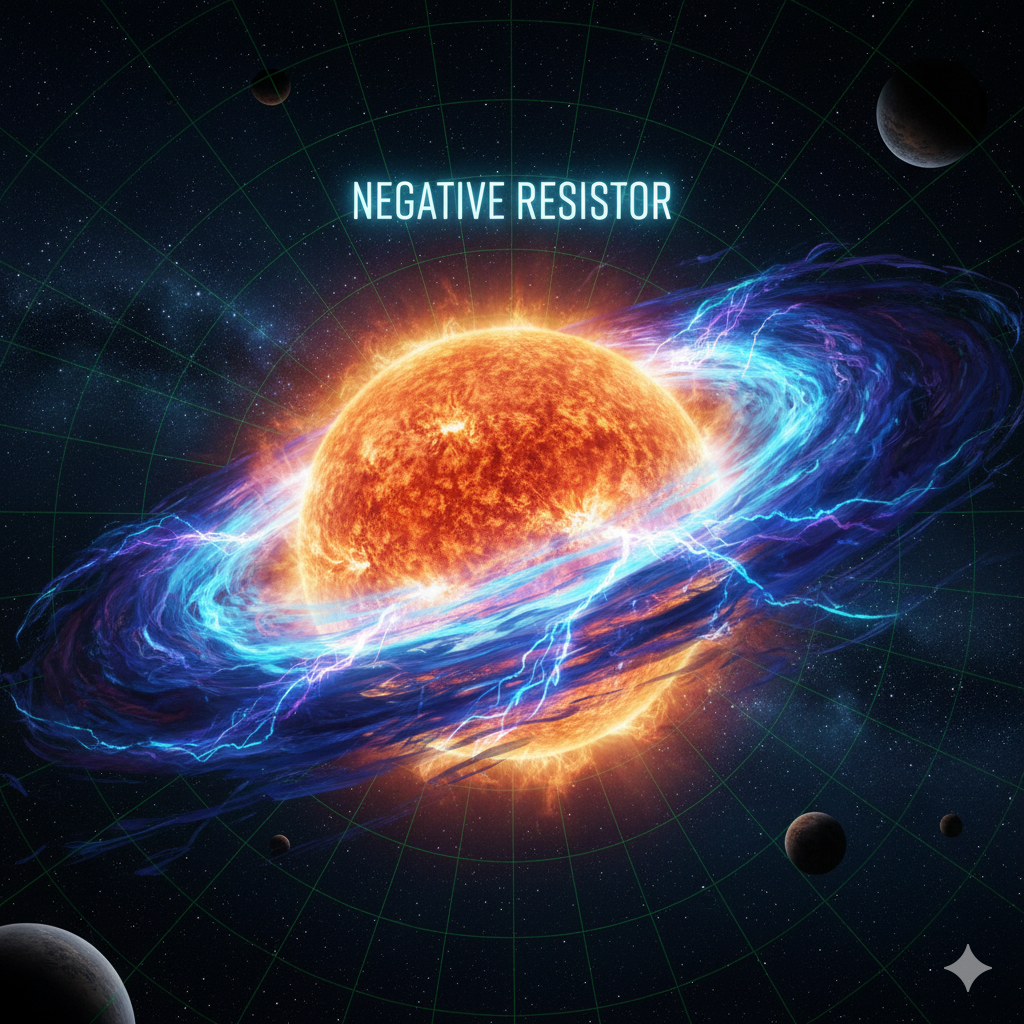
One specific technical structure that allows the sun to maintain its negative properties is the plasma double layer.
Plasma, the fourth state of matter, is not simply drifting aimlessly like a gas. When certain conditions are met, it possesses the property of creating a skin that separates its inside from its outside. This is called a double layer (electric double layer).
In ordinary matter, a boundary simply signifies an end, but in plasma, the double layer is the starting point where energy is explosively accelerated. It is a region where positive ions and negative electrons face away from each other in an extremely narrow space, forming a cliff of intense potential.
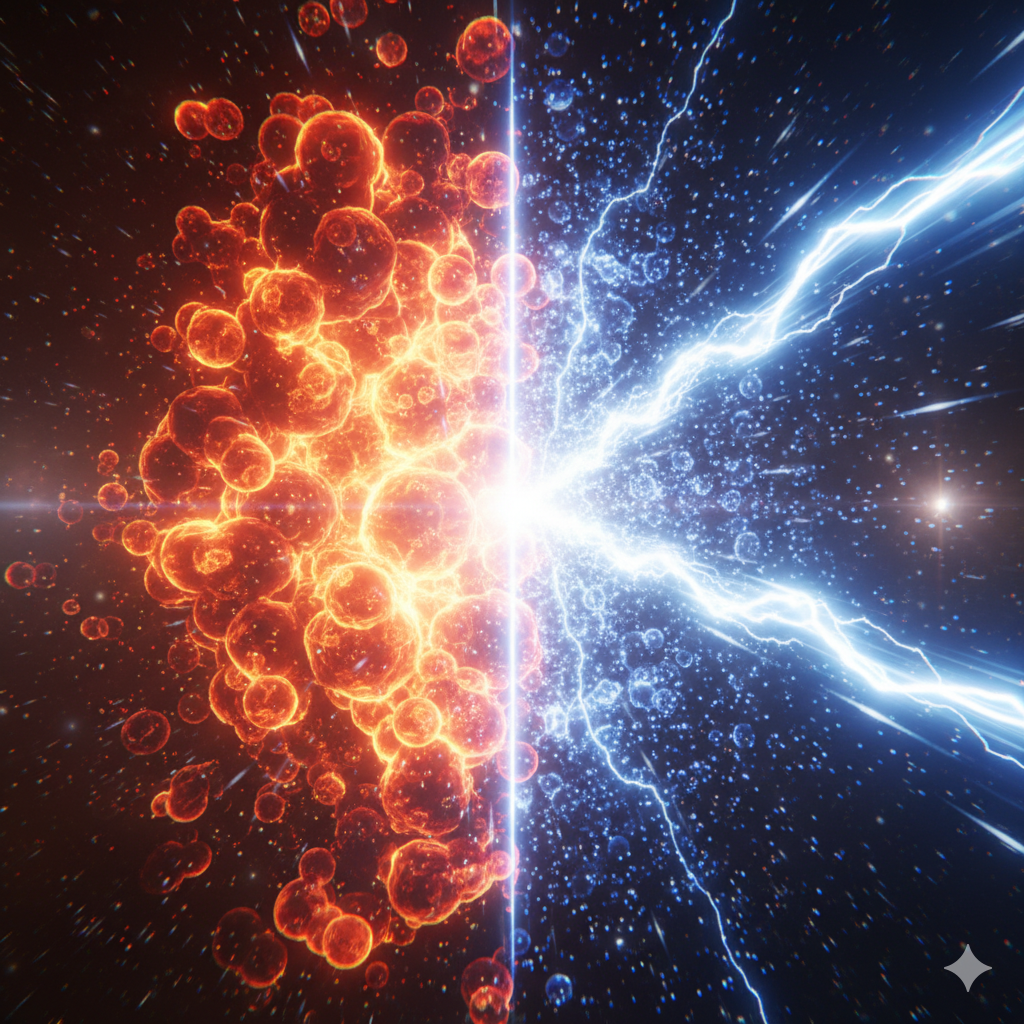
Inside the silent double-layer accelerator, the usual Ohm’s law V = IR is completely invalidated. Here, instead of a harmonious marriage of voltage and current, a nonlinear drama unfolds where they intensely attract each other while simultaneously repelling one another. Electrons that step into the electron double-layer, tumbling down a cliff of potential, are instantly accelerated by this steep potential cliff. A small trigger power supplied from the outside is amplified as it passes through this cliff, drawing in the potential of space (vacuum).
Physically speaking, in the process of converting potential energy into kinetic energy, there is a moment when more work is done on the entire system than the input from the external circuitry.
K = \frac{1}{2}mv^2 = e \cdot \Delta \PhiThis potential difference is the microscopic reduction of the tension between the atmosphere and the earth that Tesla discovered. The double layer is the cosmic interpreter, translating the invisible tension (electric field) that fills space into visible electron flows (electric current).
The answer to the mystery of the solar corona’s high temperature also lies in this double layer. The vast plasma layer covering the sun’s surface harbors countless sparks of double layers. These aren’t carrying heat from the sun’s interior. Rather, the double layer, acting as a “skin,” accelerates the electromagnetic tension flowing in from the infinite capacitor of space, harvesting it as thermal energy exceeding one million degrees. The sun isn’t burning; it’s breathing in energy with its double-layer lungs, in sync with the universe’s breath.
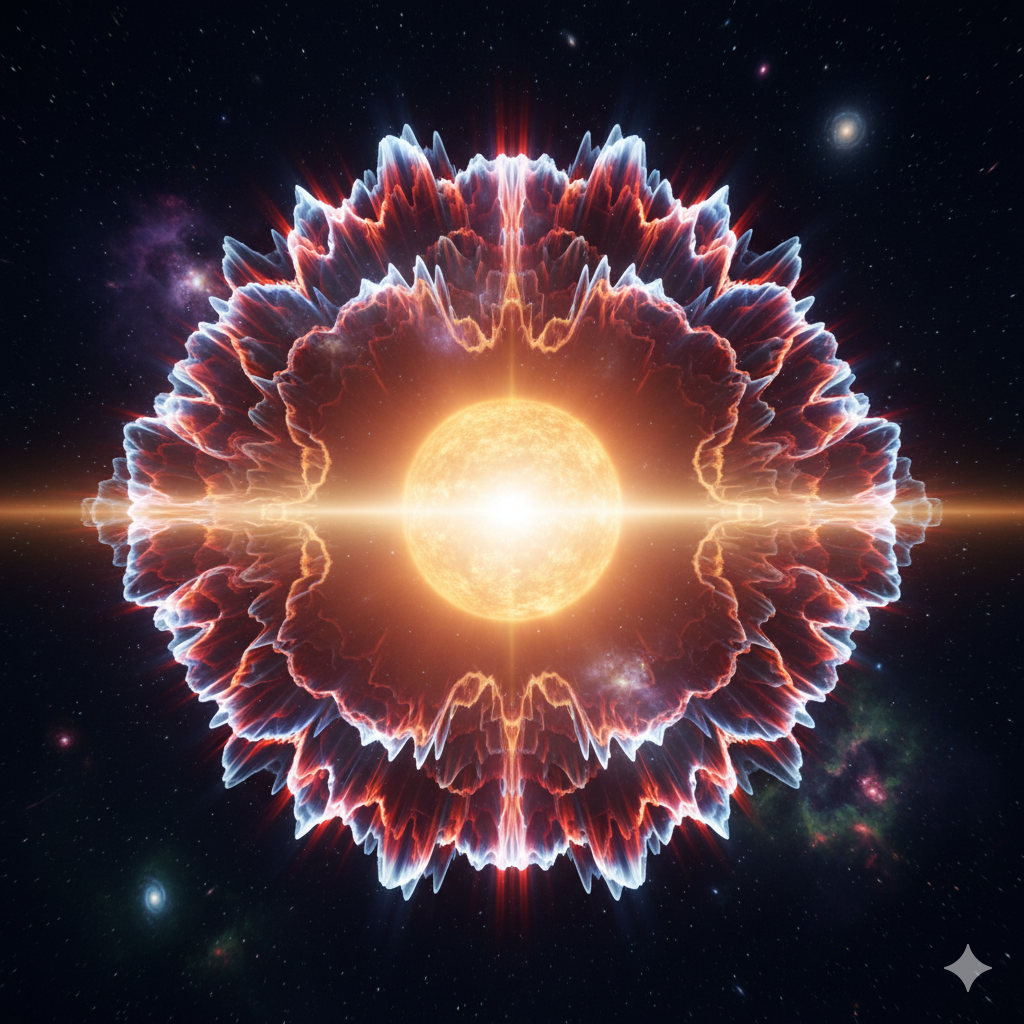
Tiny particles and energy flowing in from outer space are explosively accelerated as they pass through this double layer.
When this acceleration rhythm synchronizes with the sun’s overall natural oscillation, the negative properties are maximized.
The amplified energy can no longer remain inside the sun and spills out into space as solar wind and light.
When a plasma double layer (two layers) forms, under certain conditions, regions where the plasma mysteriously disappears (such as the Faraday dark zone) may appear. When this “acceleration cliff” of the double layer appears, a seemingly lightless “dark gap” is created. However, this is precisely the “gateway to the void” through which energy flows in like a raging torrent from space. Sunspots may also be entry points for this enormous energy influx.
In this negative resistance model, gravity itself is an “energy inflow vortex.”
Gravity may be the pulling force that arises when the tension in space is drawn to one point by the negative resistance of plasma.
Conversely, it’s not that energy gathers because the sun is massive, but rather that immense gravity (space distortion) may be generated there precisely because it is drawing in energy.
[The Sacred Vessel] The Mystery of Standing Waves that Fix Space
For ancient people, the sun was the great heart that powered the world, but even we, with our advanced observational equipment, do not understand the true nature of its pulsation at the same level as them, or even more. We have the means to measure the amount of energy the sun emits, but we remain blind to the fact that its quality is drawn as a gain from the void (vacuum) of the universe.
If you were to cut the sun in half with a knife, the inside would be filled with plasma. This is also the source of the light that reaches us.
However, we are unaware of the existence of this plasma.
The sun is not a giant nuclear fusion reactor. It is a gigantic “negative resistance plasma body” floating in the ocean of infinite potential that is the universe.
A grid that fixes energy in space
The Great Pyramid of Giza towers over the desert. Modern academia has buried its true function in the shadows of history by defining this megalithic mountain as the tomb of the pharaohs. However, those who actually step inside, especially into the “King’s Chamber,” feel not the silence of death, but an eerie pulsation, as if the space itself is trembling.
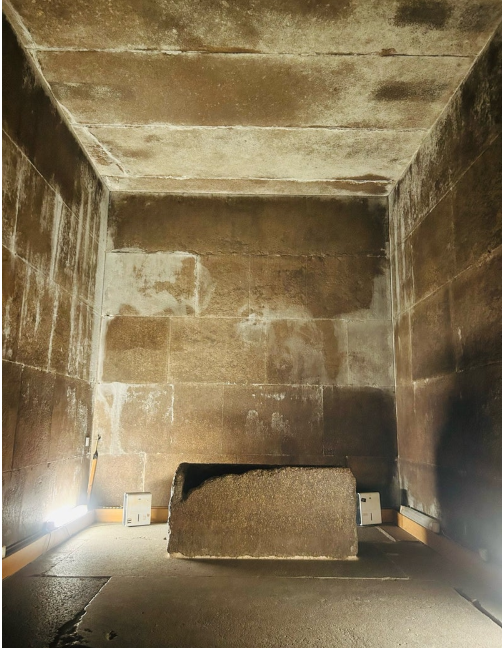
There are no mummies, no burial goods, not even a single piece of decoration. All that remains are precisely cut red granite walls and empty stone sarcophagi.
For the ancients, this space was not a place to bury souls. It was a cosmic resonator, a mechanism to sew the breath of the sun into a specific space, sublimating it into eternal life (a standing wave).
The red granite that makes up the walls of the King’s Chamber contains a large amount of quartz. Quartz is a substance that exhibits the piezoelectric effect, generating electricity when physical pressure is applied.
Above the King’s Chamber, a total of five layers of massive granite beams are stacked. This structure, known as the “Weight-Relieving Chamber,” is not simply for supporting the ceiling. It is an intricate design that deliberately applies thousands of tons of pressure to the granite, keeping the quartz crystals constantly under electromagnetic tension.
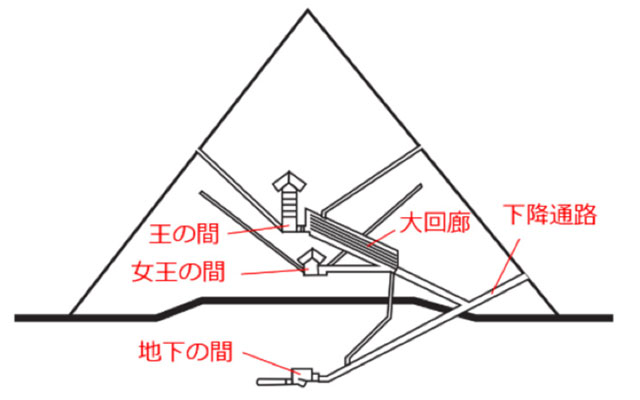
This state of tension is what allows it to function as the plates of a capacitor. And when vibrations in the form of sound are added to this tension-filled space, the stone walls begin to sing, forming a “standing wave” in the space.
Normally, energy-carrying waves (traveling waves) attenuate and dissipate as they move away from their source. However, in a meticulously designed enclosed space like the King’s Chamber, there is a moment when the outgoing wave and the returning wave reflected off the wall overlap in perfect rhythm.
At this point, the wave stops moving, remains in place, and begins to pulsate violently. This is a “standing wave.”
When a standing wave is formed, an “antinode” of concentrated energy is created at a specific point in the space. The location where the stone chest in the King’s Chamber is placed is this energy “antinode,” the point where a voltage tension so strong it threatens to tear the space itself apart is maintained.
If traveling waves are like flowing water, then standing waves are like frozen water currents. The energy no longer goes anywhere; it’s pinned down in place. This makes it possible to permanently capture resources from the outside.
The ancients recreated the Earth’s song (Schumann resonance) that Tesla heard in Colorado Springs, using the granite vessels of the pyramids. The dimensions of the King’s Chamber were calculated to harmonize with the Earth’s natural frequency, or the Sun’s pulsation. This energy was amplified within the small “vessel” of the King’s Chamber. Once the standing wave was fixed, it became an energy grid that divided space in all directions. This was the true nature of the meterless ocean of energy that Tesla aimed for in his world system.

In modern times, music is the closest way we encounter standing waves. When you pluck a guitar string or blow into a flute, what’s created is undeniably a standing wave.
Because both ends of the string are fixed, the waves reflect off the ends and repeat the cycle. Only at specific frequencies do the waves reinforce each other, fixing the sound as a standing wave.
The resonance of a wind instrument also creates a phenomenon where air inside the tube moves back and forth, causing the air to vibrate intensely at certain points and then become still at other points.
The microwave oven, a staple in modern kitchens, is also a device that confines standing waves within a cage. Microwaves emitted into the oven reflect off the metal walls, forming complex standing waves inside. At the “antinodes” of the standing wave, molecules vibrate intensely and heat up, but at the “nodes,” no heat is transferred at all. The rotating plate inside a microwave oven prevents food from remaining stuck at these “nodes” (points that don’t heat up).
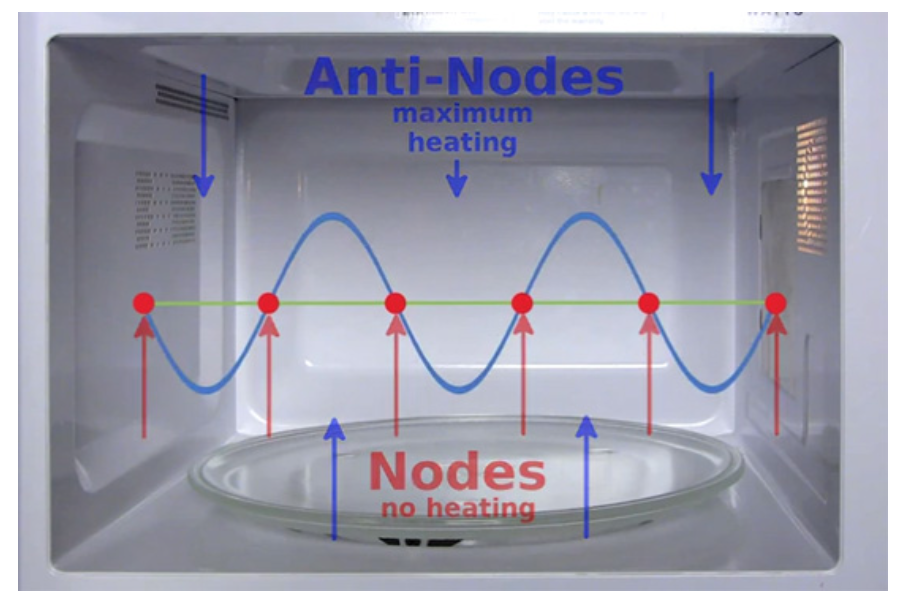
If the plate doesn’t rotate, uneven heating will occur. This is the most readily apparent proof that energy can be fixed and immobile within space. This is nothing less than a demonstration of the fact that energy can be pinned to a specific space.
In wireless communication such as smartphones and Wi-Fi, the metric that engineers are most concerned with is VSWR (Voltage Standing Wave Ratio). When radio waves emitted from an antenna bounce back due to mismatches in cables and connectors, unwanted standing waves are generated. In modern communications engineering, these standing waves are thoroughly eliminated as they are a cause of loss and equipment failure. Why do they dislike standing waves? Because energy remains in place instead of flowing out of the antenna.
テスラの世界システムにおいて、彼はこの戻ってくる波を排除するのではなく、積極的に利用した 。往復する波を同期させ、地球全体を巨大な定常波の器とすることで、エネルギーを空間に固定しようとしたのである。定常波が成立し、エネルギーがその場に固定されてしまえば、もはやメーターで流量を測ることは不可能になる。
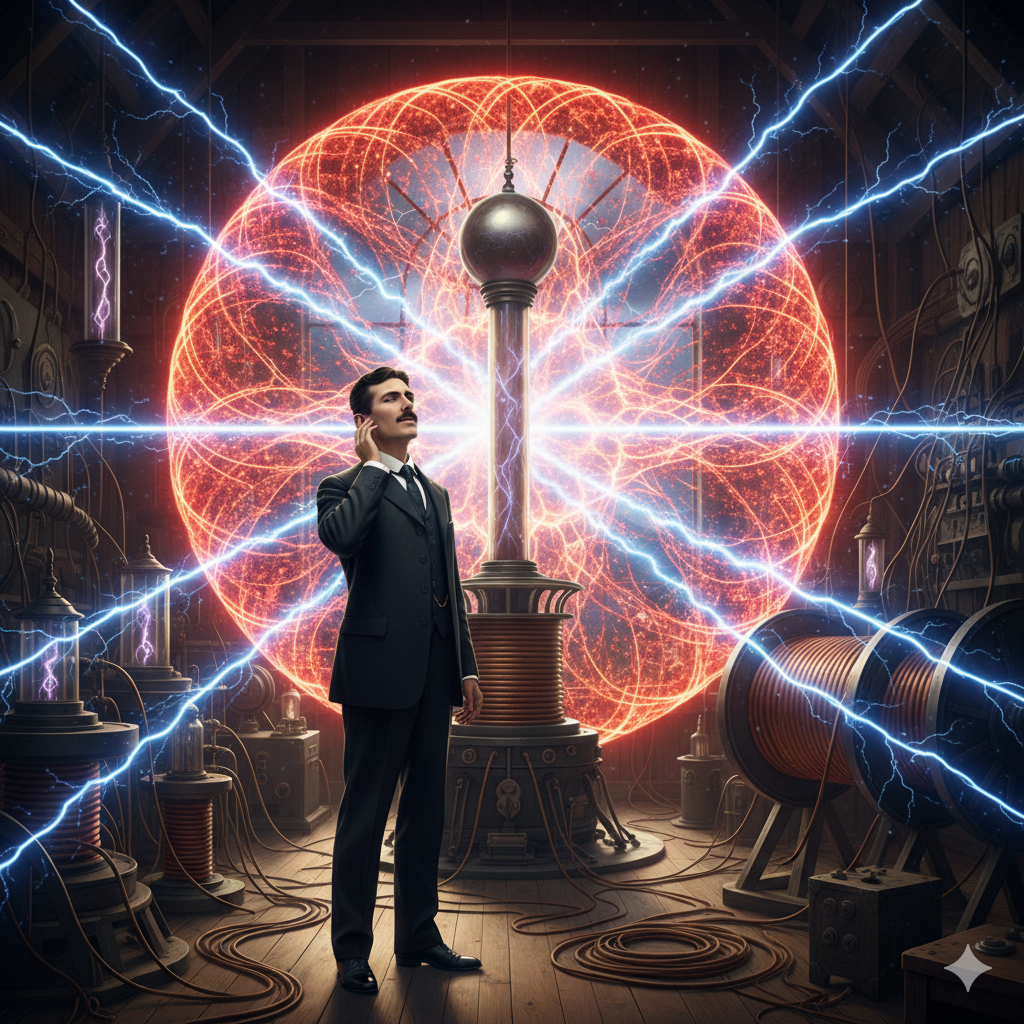
Even in quantum mechanics, the cutting edge of modern physics, standing waves are treated as the very building blocks of the universe. The electron orbits derived from Schrödinger’s equation are nothing more than standing waves—the electron cloud—formed around the atomic nucleus.
Atoms can exist stably because electrons form standing waves at specific frequencies, and their energy is “fixed” in place. From microscopic atoms to macroscopic stars, and even the king’s chamber in a pyramid, everything holds energy within the vessel of standing waves. Matter is the energy of space “frozen” by standing waves.
When these immovable standing waves form within the medium of air, an invisible energy grid appears.
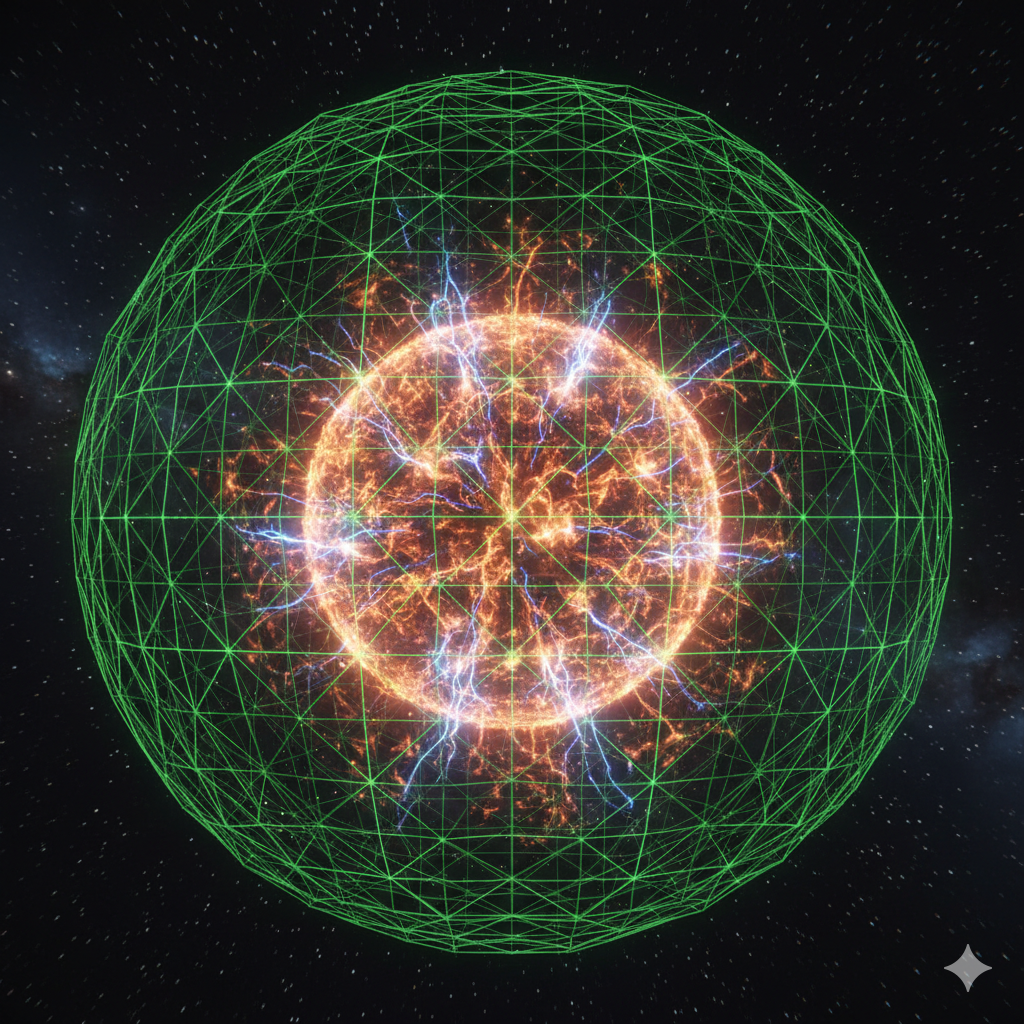
When matter (such as a water droplet or a small component) is introduced into this standing wave, it is pushed out by the intense vibrations of the “antinodes” and escapes to the “nodes,” which are the quietest points. Here, an equilibrium point is created where gravity and the radiation pressure of the standing wave (the force that tries to hold the matter in place at the nodes) are perfectly balanced. The matter then autonomously comes to rest, as if placed on a transparent shelf suspended in space. This is the true nature of levitation by standing waves.
Why can mere “sound” possess the power to support matter?
This is because standing waves periodically alter the density of space, creating a tangible force known as acoustic radiation pressure.
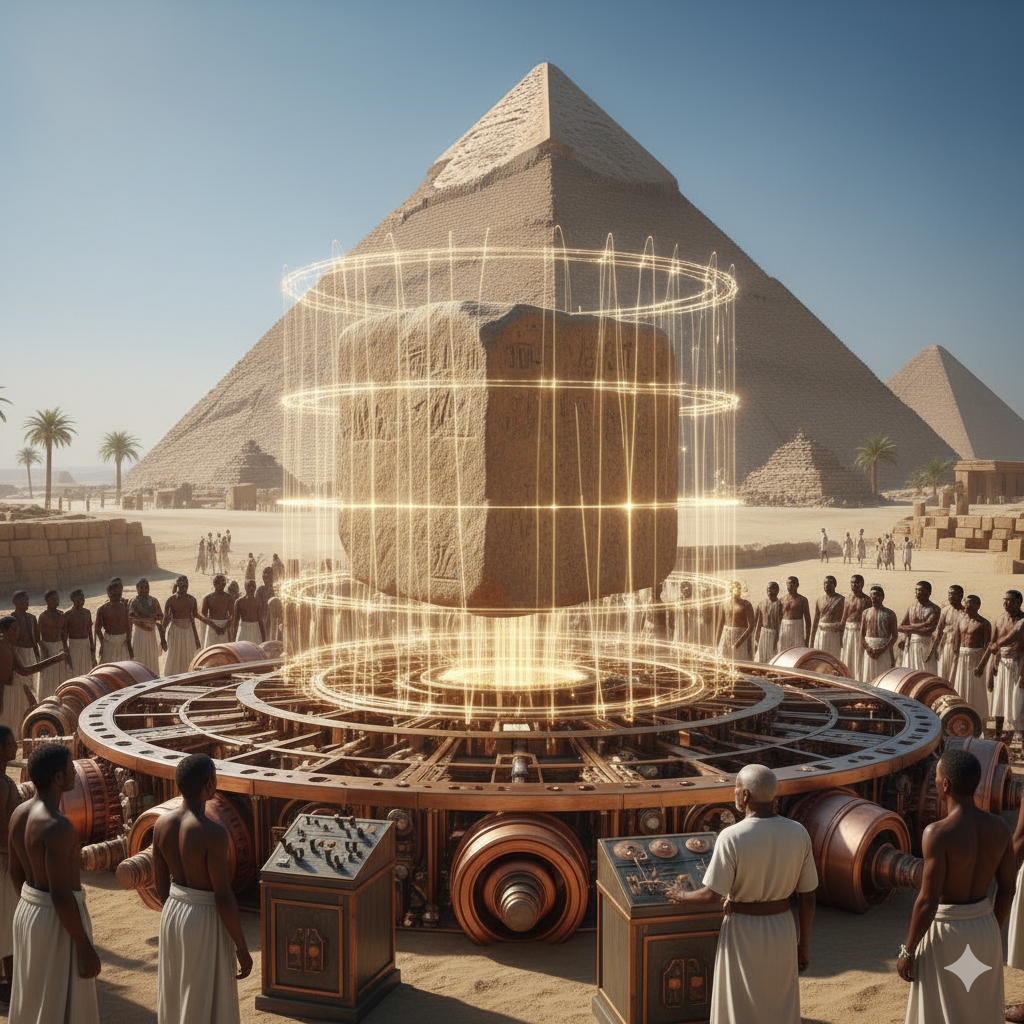
A popular urban legend claims that the ancient Egyptians used sound to levitate and transport massive stones. While academia scoffs at this, for those who understand the principles of standing waves, it’s not entirely a far-fetched fantasy. In the “King’s Chamber” of the pyramids, certain granite beams are constantly subjected to thousands of tons of pressure, emitting electromagnetic tension through the piezoelectric effect. If the Earth’s natural frequency (Schumann resonance) were amplified and fixed as a standing wave in that space, a field would have been created that guided matter to a specific location.
They may not have fought gravity directly, but rather neutralized it by incorporating and harmonizing it within the rhythm of standing waves.
We are led to believe that moving objects requires either direct contact or visible thrust.
Hand strength is needed to carry heavy loads, and a massive fuel jet is required to launch a rocket. This rugged physics of action and reaction forms the basis of the logic that defines energy as something consumed by brute force.
However, what standing waves reveal is something entirely different: a serene and irresistible will of space.
In a space where standing waves occur, the uniform air or ether that should be there instantly transforms into a structure. When waves overlap and decide to remain in place, a grid appears in space, consisting of violently pulsating “antinodes” and eerily still “nodes” alternating.
At this point in space, the pressure fluctuation is at its maximum. It generates an intense repulsive force, as if space itself were violently pushing back against the matter.
In contrast, at the nodes, space becomes silent.
For matter pushed out from the antinode, this is the only place of rest in this frenzied space. At this point, space is no longer an empty expanse, but begins to function as a sophisticated machine equipped with “invisible shelves” and “invisible hands” to guide, fix, or transport matter to specific locations.
Why can a mere wave lift and stop an object? Behind the phenomenon that modern science calls acoustic radiation pressure lies a dramatic process in which the potential of space is translated into force. From the “antinode” to the “node” of a standing wave, a steep cliff appears in the energy density of space.
F = -\nabla UThis equation signifies a fundamental cosmic law: matter is always drawn to areas of lower energy density (stable locations). It’s the same principle as water flowing from a higher to a lower position.
In modern laboratories, this force is used to suspend and fix water droplets, tiny electronic components, and even living insects without any physical contact.
It allows us to pin matter to specific coordinates without physical contact.
The downward force of gravity is counteracted by the upward radiation pressure of standing waves, treating space as a charged crystal. While this phenomenon has been confined to specific experimental equipment, it is essentially proof that “geometry can transform space into a physical cage.”
Chladni figures
In the late 18th century, German physicist Ernst Chladni succeeded in bringing sound, previously considered merely a vanishing phenomenon, into the material dimension.
He discovered that by rubbing the edge of a metal plate with a violin bow to create vibrations, fine sand scattered on top would reveal eerily orderly geometric patterns. These are known as Chladni figures.
This phenomenon astonished even Napoleon at the time, making the fact that sound has form known throughout Europe.
The mechanism by which Chladni figures are created is the very structure of space by standing waves.
When standing waves are formed, boundaries are created on the plate between intensely pulsating “antinodes” and completely still “nodes.”
In other words, the patterns that emerge as Chladni figures are the “node lines” of the standing waves.
The sand grains are drawn to the “stable places” where the spatial potential is lowest, resulting in the creation of geometric patterns.
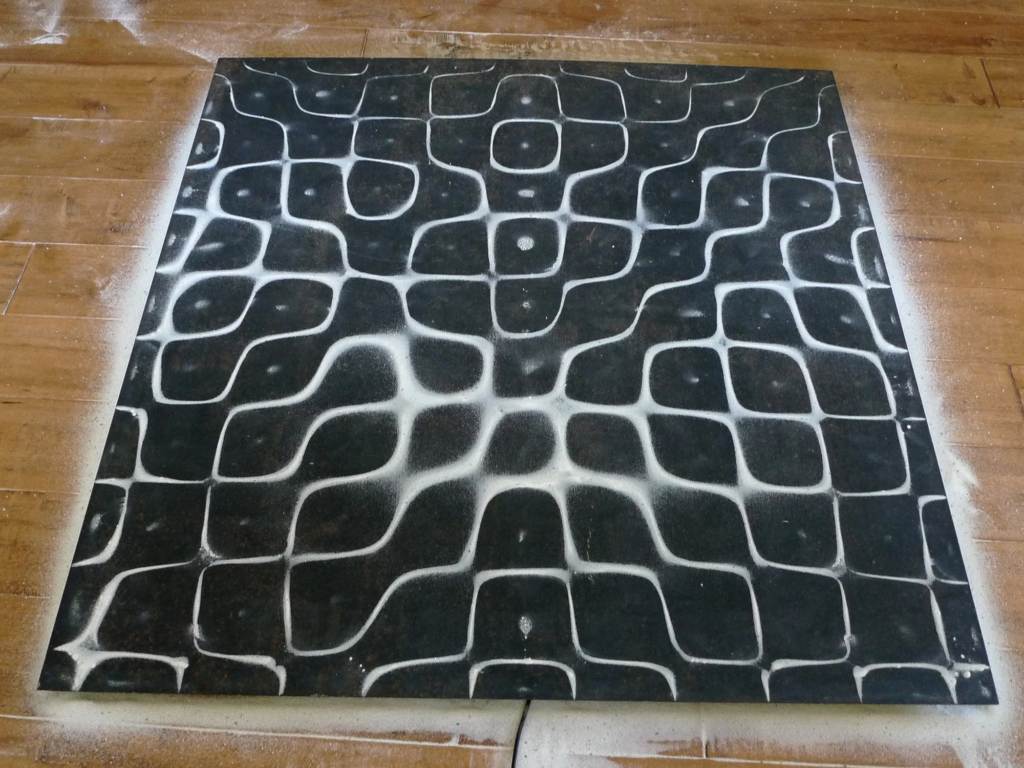
The higher the vibration frequency, the more “nodes” there are in the standing wave, and the more complex and sophisticated the resulting patterns become. This means that the higher the energy density, the more intricate the blueprint etched into space becomes.
The scattered grains of sand, the moment vibration is applied, are stripped of their own will and forced to conform to the geometric patterns prepared by space.
Invisible information in the form of sound manifests itself as a shape in this world, borrowing the medium of matter. This is irrefutable evidence that standing waves are not merely vibrations, but blueprints that physically structure space.
UFO operating principles
As we have previously dissected, standing waves are clearly a grid of energy “nodes” and “antinodes” fixed in space.
Normally, this grid is fixed at the geometric center of the device, but what if we could dynamically slide the position of this grid through sophisticated tuning using software-defined radio (SDR)?
The “antinodes” of a standing wave are points where the spatial potential is maximized, generating intense radiation pressure. If the position of these “antinodes” is continuously shifted just a few millimeters forward in the direction of propagation, the device will begin to accelerate smoothly, as if being drawn into the spatial gradient it has created.
This isn’t about repelling gravity, but rather about creating a small vortex of distortion within the vast spatial distortion of gravity, and riding the ripples. Instead of forcefully pushing forward by firing fuel like existing rockets, it moves by “grabbing and pulling” the grid of space.
Many eyewitness accounts of flying saucers have described them as moving in a zigzag pattern and making sudden stops that defy inertia. This can be explained by the fact that they moved not by physical mass, but by a grid of standing waves.
Because the device is fixed to the grid of space itself, even with rapid acceleration or sharp turns, the occupants (or the precise circuitry) inside do not experience G-force (acceleration). Since space itself is moving, time inside remains calm.
When a normal vehicle accelerates, a force acts on our bodies in the opposite direction of travel. This is the law of inertia in physics, the resistance that arises when an object tries to move forward by pushing aside the stationary background of space. However, in a UFO that manipulates a standing wave grid, this resistance is theoretically zero. The movement of a UFO, which slides along a cliff in space rather than moving itself, is fundamentally different in principle from how we drive on roads.
During movement, the aircraft doesn’t propel itself through space with its engines, but rather rapidly shifts the phase of the surrounding standing wave grid. It slides the “antinode” of the standing wave in front of the aircraft forward, forcing the “antinode” behind it into position. The aircraft constantly remains at the “center (node) of the spatial distortion” it creates.
This is the same principle as a surfer who rides waves rather than swimming on their own. The surfer remains stationary relative to the wave’s slope.
Even if the wave is moving at 100 km/h, as long as the surfer maintains a specific position on the slope, they experience no acceleration shock (G-force). Inside the UFO, both the aircraft and its crew remain fixed on the nodes of the standing waves, and the nodes themselves slide through space. Therefore, even sudden stops or sharp turns cause no fluctuations in the internal inertial frame.
We feel weight and the shock of acceleration because matter is creating friction with the background radiation (zero-point energy) in space.
F = \frac{dp}{dt}This change in momentum presses our bodies against the seats. However, by uniformly controlling the spatial density around the aircraft using standing waves, and integrating the aircraft itself with the nodes of space, there is no room for physical friction. The reason UFOs glow brightly and disappear silently at right angles is simply because they are not flying as physical objects, but moving as the focal point of a phenomenon inscribed in space.
This way of being fixed in space as a “focal point of a phenomenon,” freed from friction with background radiation, is not limited to advanced navigation by unknown intelligent life forms.
In the laws of the universe, there is no essential distinction between microscopic artificial devices and macroscopic celestial bodies; the same physical laws manifest on a gigantic scale in our sun.
The sun’s plasma and standing waves are not merely related; they are physical conditions necessary for the sun to continue shining as the sun.
The sun and standing waves
This book deconstructs the truth about the sun and standing waves, based on the principles of the universe, a truth that cannot be reached through the logic of a “burning ball of fire.”
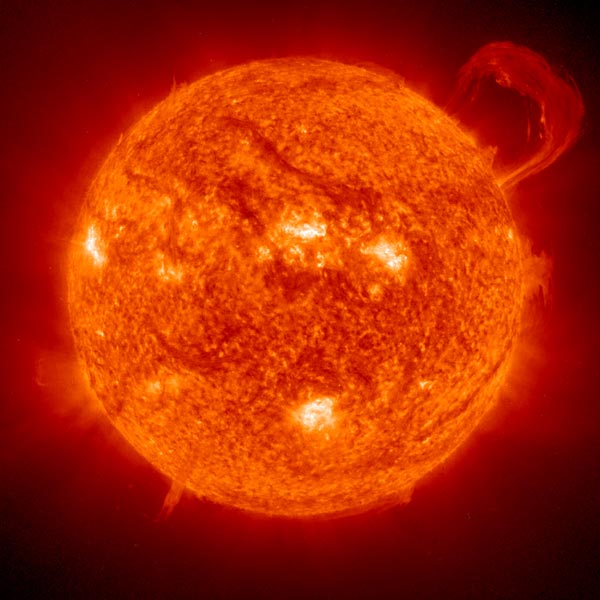
The sun is not merely a mass of gas, but a gigantic musical instrument filled with a fluid called plasma. Modern helioseismic science has confirmed that countless waves constantly reciprocate within the sun, overlapping at specific frequencies to form “standing waves.”
Sound waves traveling through the Sun’s interior reflect off its surface and travel back and forth, forming standing waves. This causes the Sun’s surface to pulsate (vibrate) regularly with a period of several minutes.
In the Sun’s depths, gravity acts as a restoring force, generating standing waves and creating the rhythm of the entire star’s energy cycle.
When the sun’s plasma synchronizes with these standing waves, an astonishing phenomenon occurs.
When standing waves form, vibrational “antinodes” are created in space. At these “antinodes,” the sun concentrates the immense potential energy it has drawn in from outer space (the vacuum), trapping it and preventing its escape.
The corona, above the sun’s surface, is hotter because this standing wave concentrates and releases energy at the “antinodes” (upper atmosphere), explosively accelerating the plasma there.
For the sun to function as a “negative resistance plasma body,” this cage of standing waves is essential.
Plasma entering the negative resistance region absorbs energy from the outside, but this absorption is not random. It maintains a stable glow by repeatedly inhaling and exhaling energy in accordance with the rhythm (pulsation) of the sun’s overall standing waves, as if breathing. It’s almost like a living organism…
“The sun receives energy as fuel from the void of space by emitting standing waves. The reason the sun doesn’t burn out is because it continuously accumulates the blessings of the universe within this cage of standing waves.”
As long as this balance of standing waves remains undisturbed, the sun will continue to exist.


コメント